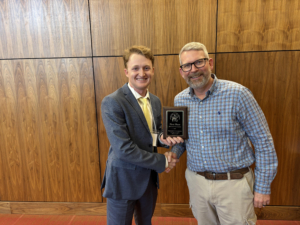
Aiden Ross and Noah Chandler are First Place Winners in the Masters Student Competition at the ACPA Research Conference
Ross won a first place award with a presentation titled Preemergence Control Options for White Margin Sedge. White margin sedge (Cyperus macrostachyos Lam.) is a newcomer as a problem weed in Arkansas rice (Oryza sativa L.) and has quickly increased in severity and spread since it was first identified as an issue on a Poinsett County farm in 2014. WSSA Group 2 herbicides, such as halosulfuron-methyl (Permit), are typically the best control option for sedge(Cyperus spp.) weeds in-crop, but white margin sedge has developed widespread resistance to these herbicides through an Asp-376-Glu substitution in its acetolactate synthase (ALS), the target site of Group 2 herbicides. Very little is known about controlling this new problem weed, and the failure of Group 2 chemicals exacerbates the need for solutions. In an ongoing greenhouse experiment, three accessions of white margin sedge and one accession of rice flatsedge (Cyperus iria L.) were tested against 15 different preemergence herbicides labeled for use in rice and/or soybean [Glycine max (L.) Merr.]: halosulfuron-methyl, imazethapyr, quinclorac, metribuzin, fluridone, saflufenacil, sulfentrazone, oxyfluorfen, fomesafen, acetochlor, S-metolachlor, pyroxasulfone, dimethenamid-P, thiobencarb, and mesotrione. The study was laid out in a completely randomized design with four replications. Data are still being collected and analyzed for final results, with the measures being visual control (0 to 100%), groundcover analyzed via TurfAnalyzer, plant leaf counts, and aboveground biomass. Notable observations, however, include better than 95% control of both weeds provided by acetochlor, S-metolachlor, pyroxasulfone, dimethenamid-P, fluridone, sulfentrazone, and oxyfluorfen; as well as the poor performance of halosulfuron-methyl, imazethapyr, and quinclorac.
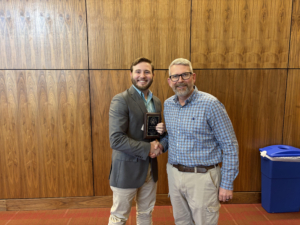
Chandler won a first place award with a presentation titled Clethodim Tank Mixtures for Control of Barnyardgrass and Weedy Rice in HT3 and ROXY rice. Arkansas rice production faces many challenges, namely, herbicide-resistant weeds. According to Arkansas growers and industry workers, two of the most problematic rice weeds are barnyardgrass (Echinochloa crus-galli) and weedy rice (Oryza sativa). Albaugh LLC. and Cibus Inc. propose a potential solution to these problematic weeds by releasing the HT3 rice (clethodim resistance) trait, combined with the ROXY rice (oxyfluorfen resistance). Two studies were conducted in 2025 to evaluate clethodim and oxyfluorfen as tank mixtures for control of barnyardgrass and weedy rice. The studies were conducted in Fayetteville and near Colt, AR, as a randomized complete block design with four replications. The treatments evaluated were clethodim alone, two rates of oxyfluorfen alone, and clethodim mixed with both oxyfluorfen rates. The treatments were applied to 3-leaf weedy rice and barnyardgrass. Visual control ratings were taken relative to the non-treated at 14, 21, and 28 days after treatment, along with above-ground biomass at the last rating. Colby’s method (E = A+B * (A-B)/100) was used to calculate an expected response (E) for each mixture and to deem it antagonistic, synergistic, or additive by comparing E and the observed response. Improved weedy rice control was achieved with both tank mixtures, with the Colt location (quizalofop-resistant weedy rice) and Fayetteville location (quizalofop-susceptible weedy rice) showing synergy when clethodim was mixed with the high rate of oxyfluorfen. At both locations and across all treatments, effective barnyardgrass control was achieved with the mixtures. These results indicate that clethodim plus oxyfluorfen can be a good control option for barnyardgrass and weedy rice, including quizalofop-resistant populations.