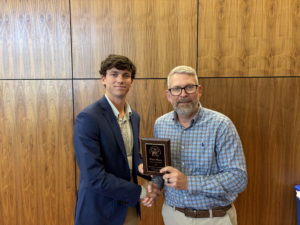
James Malone Wins ACPA Research Conference Poster Competition
Malone won a first place award with a poster titled Cotton Response to Postemergence Herbicide Applications Across ThryvOnTM and Non-ThryvOnTM Technologies. Early postemergence (POST) applications in cotton (Gossypium hirsutum) are a pivotal tool in any weed control program. However, there is the potential for crop injury in some early POST applications. Early-season cotton growth is also heavily affected by thrips feeding. The timing of thrips infestations aligning with stress from early postemergence herbicides can result in delays and potential stand loss. The objective of this experiment was to evaluate potential interactions between POST herbicide injury and thrips damage in ThryvOn™ and non-ThryvOn™ cotton technologies. Research was conducted in 2025 at the Lon Mann Cotton Branch Experiment Station in Marianna, AR. The experiment was designed as a randomized complete block with a split-plot arrangement, including 16 treatments and four replications. The experiment was a factorial arrangement of treatments with cotton technology and seed treatment as the whole-plot factors, followed by POST herbicide program as the sub-plot factor. Three different herbicide programs were evaluated within this experiment across both treated and untreated plots of ThryvOnTM and Non-ThryvOnTM technologies. The herbicide programs evaluated include glufosinate-L (Liberty Ultra®) applied alone, glufosinate-L, dimethenamid-P (Outlook®), and glyphosate (Roundup Powermax 3®) applied as a tank-mixture, dicamba (Xtendimax®) and glyphosate applied as a tank-mixture, followed by no application at the 2- to 3-leaf maturity level. The seed treatment evaluated was Gaucho® at 0.375 mg/seed. Necrosis, chlorosis, and thrip damage ratings were taken at 7, 14, 21, and 28 days after treatment (DAT). Node counts and plant heights were also collected throughout the growing season. No interaction was observed between herbicide injury and thrips damage. The lowest herbicide injury was observed with dicamba, ranging from 0 to 7%. The highest injury occurred with a tank mixture of dimethenamid-P, glufosinate-L, and glyphosate, at 30-35%. Increased thrips damage resulted from applications that included dimethenamid-P and glufosinate-L; however, no direct correlation between injury and thrips damage was observed. Yield data will be presented, but the results were not complete at the time of submission of this abstract.